

Impious since 2006
Showing posts with label consumers. Show all posts
Showing posts with label consumers. Show all posts
Dec 25, 2018


Nov 8, 2017
The Wedding of Time Warner and AT&T

The United States Department of Justice said that Time Warner and AT&T can go ahead with their merger plans but only if they dump - the word they used was "divest" - CNN as part of the deal.
Time Warner (meaning, Ted Turner) flipped the judge the bird and the two are reportedly on their way to Vegas to get hitched by Elvis.
The two giant companies don't have a registry set up, however, in lieu of gifts, you can send cash. Mounds and mounds of cash.
Apr 26, 2017

Jan 1, 2011
Oh, Those Opulent O’s.
We’ve come to the end of a decade - yes, I start counting my decades by the ones and not the zeroes, which means that 1980 was the last year of the 70’s. I know it looks stupid on paper, but it is the proper way. My reference point would be the classic Onion Headline - “The Millennium Begins in 2001, Terrorists Note.”
In the grand tradition of rehashing old news and making sub-standard lists of events, arbitrary lists of the ‘best’ movies or music, reality television ‘stars’, or worst of all - consumer products - allow me the exercise of looking back with the rose colored glasses of time. I’d like to try to present the previous ten years as it might show up in a history book.
The Opulent O's
Previous eras of the American experience have been labeled, whether accurately or not, by the generations that followed. The eras of the Gilded Age, the Roaring Twenties, or the Fabulous Fifties give an over reaching illusion of wealth and comfort afforded by all the citizenry. Careful study shows that there were major exceptions ranked by class status and race in each of these three examples, and the names themselves discount recessionary times, and any turmoil that existed. However, the tradition of remembrance for a grouping of ten years with a fantastical moniker has become an unfortunate reality of historical narrative when examining the history of America. The era that we are focusing on now is no exception -- the era which begins at the turn of the 21st Century to the new year of 2011 CE. This time has become known as the Opulent O’s.
To first explain the name of the era, the people of the time did not refer to the year in which they lived as the aughts, or oughts as proper English would dictate, or even the example of the generation that lived through the turn of the previous century, the 1900’s. The pronunciation of the year in which they lived predominantly was spoken as, “two thousand and...” followed by the number designate. Hence, why a few historians have refereed to the era as the ‘And’s’. The consensus by reputable sources and careful research has been to designate this time as the ‘Oh’s.’ The evidence in the historical record suggests that the people of the time would sometimes drop the ‘two thousand’ in speech and would simply state, “Oh six,” when giving a descriptor of a year; as an example.
The word Opulent has become to describe the era. The Latin derived definition in English are defined as 1. Having or indicating wealth, and also 2. Abundant or plentiful. Ignoring race or regional exceptions -- the word perfectly defines the era.
The primary fuel of the time was cheap and easily obtained petroleum drilled from the ground. The peak of use of gasoline and plastic derived from oil occurred in this era. The abundance of cheap oil and fuel allowed for cheap food sources. The importance of oil in the life cycle of plant to waste product must be studied to understand the mindset of the time. The availability and sheer amounts of cheap fuel created a cradle-to-grave manufacturing cycle from consumer goods to 4 ton single passenger vehicle with low fuel to kilometer use ratios -- which defines the zeitgeist. The most important aspect, in hindsight, to the lifestyle of the times was the amount of fuel used to create inexpensive food. The petroleum was used in the creation of fertilizer, and copious amounts were used in the entire process of seed to market, and market to aftermarket production.
Simplified, the oil or oil products would be used by the farmer from every aspect of his production -- from the multiple passes on a tractor (soil toiling, planting, chemical pesticide application, cultivation and a final till of the soil), to transport to industrial food processing off site (sometimes thousands of miles) from the farmland. Next, from the secondary processor which would create a chemical byproduct of the original agricultural product (Maize and soybeans being the most popular of the bases found in most supermarkets [see also ADM Corporation] would then transport and package the new product and ship by truck to market. Retail supermarkets [Safeway, Albertsons], “fast food” restaurants [McDonald’s, Chili’s] or superstore retail outlets [Costco, Wal-Mart] would then cater to the final end user, who more often than not, used a single passenger vehicle to transport the product home. Once the product was consumed, the end user simply disposed of the plastic packaging to preserve the food product, and the outer container -- typically another plastic or cardboard package which only served to encourage purchase. Once discarded the packaging materials were then transported by another gas powered truck or transport to take the used goods to be covered in a landfill. The concept of cradle to cradle manufacturing may have germinated in this era, but due to the nature and scale of the single-use economic cycle, it was counter productive or even suicidal for any industry to adopt a plan to reuse or recycle their resources or waste products.
Since fuel and food were inexpensive, the lifestyle of the typical American of the Opulent O’s were filled with store bought conveniences and electronic trinkets designed for obsolescence which encouraged constant replacement. Leveraged credit based upon elevated housing prices allowed consumers buying power. It was not uncommon for an American to have bought a home past their means, and taken credit based on that home’s perceived market value, called a home equity loan. These funds were then used to purchase more consumer goods -- and often with a credit card [MasterCard, Visa]. The economy was primarily based on the spending habits of the consumer. Even after the terrorist attacks on September 11, 2001, President George W. Bush urged Americans to go to the malls, and purchase houses and cars to get the economy engine moving again. The government created an environment of low interest rates and extremely easy credit in order to facilitate the consumer’s appetite.
Two major military engagements were initiated in response to the sensational terrorist attacks in America, under the banner of a “War on Terrorism.” The engagements in Afghanistan were aided by the Allied Western NATO nations, and the second invasion of Iraq resulted in the replacement of the government there, and a permanent American presence. History has shown, both of these costly involvements were to secure the oil fields, and an attempt to stabilize the region [see also Iran v America 1970-2020] -- thus insuring the flow of inexpensive oil to American business interests. Specifically those partners in Europe and China. Like the citizenry, these foreign entanglements were funded largely by credit. The U.S. had gone from a creditor nation to a debtor nation in 1988, but accelerated during the Bush and Obama Administrations.
Despite the trillions of dollars expended, the price of oil rose as industrial engines of India and China grew their GDP by 20% per year. Oil Prices rose in late 2006 because of simple supply and demand, plus speculation in the commodity markets. Soon, inflation of consumer products, fuel prices, and food began to outpace the threshold of business and consumer expendable incomes. Quickly, the slowdown of consumer spending toppled the preposterous derivative financial products of the time, wiped out the housing speculation and subsequent consumer credit bubble, and exposed widespread institutional Ponzi schemes, not dissimilar to the domino effect experienced at the end of the Roaring 1920’s.
Amazingly, the Six Corporate media companies either were misinformed or incapable of reporting the trends that were creating the problems that led to disaster, and instead reported only soft news (entertainment and sporting events which fed to their other advertising sponsored media concerns), or blatantly perpetuated partisan arguments to fill a 24 hour news cycle with surprisingly low or useless content to their audiences. The news of the day, even as late as 2010, was that of recovery and consumer confidence -- despite under reported or manipulated unemployment figures and a withering manufacturing base. Despite the ineffectual news climate, the government and other influential sources were inserting the word “unsustainable” into the collective vocabulary. At the end of the decade, even to the most optimistic, it seemed that the party was coming to a close. The start of a ‘new normal’ was discussed and contemplated.
Notable Starts: Enhanced government security, social media on networked devices, portable networked computing in communication devices, alternative energy, commercial exploration of space, TEA Party [Taxed Enough Already Party]
Influential Americans: George W. Bush (43rd President), Barack H. Obama (44th President), Larry Page and Sergey Brin, Warren Buffet, Alan Greenspan, Oprah Winfrey, Mark Zuckerburg, Steve Jobs, Sarah Palin.
Human Achievements: Completion of the Human Genome Project, Large Hadron Collider (Switzerland), 2nd Hubble Space Telescope repair by Human Astronauts, extra solar system planetoids discovered, water found on Mars and the Moon.
Notable Disasters: Terrorist Attacks on September 11th, 2001, Hurricane Katrina hits New Orleans and Mississippi, Gulf of Mexico Oil Spill, Global Warming/Climate Change.
In the grand tradition of rehashing old news and making sub-standard lists of events, arbitrary lists of the ‘best’ movies or music, reality television ‘stars’, or worst of all - consumer products - allow me the exercise of looking back with the rose colored glasses of time. I’d like to try to present the previous ten years as it might show up in a history book.
The Opulent O's
Previous eras of the American experience have been labeled, whether accurately or not, by the generations that followed. The eras of the Gilded Age, the Roaring Twenties, or the Fabulous Fifties give an over reaching illusion of wealth and comfort afforded by all the citizenry. Careful study shows that there were major exceptions ranked by class status and race in each of these three examples, and the names themselves discount recessionary times, and any turmoil that existed. However, the tradition of remembrance for a grouping of ten years with a fantastical moniker has become an unfortunate reality of historical narrative when examining the history of America. The era that we are focusing on now is no exception -- the era which begins at the turn of the 21st Century to the new year of 2011 CE. This time has become known as the Opulent O’s.
To first explain the name of the era, the people of the time did not refer to the year in which they lived as the aughts, or oughts as proper English would dictate, or even the example of the generation that lived through the turn of the previous century, the 1900’s. The pronunciation of the year in which they lived predominantly was spoken as, “two thousand and...” followed by the number designate. Hence, why a few historians have refereed to the era as the ‘And’s’. The consensus by reputable sources and careful research has been to designate this time as the ‘Oh’s.’ The evidence in the historical record suggests that the people of the time would sometimes drop the ‘two thousand’ in speech and would simply state, “Oh six,” when giving a descriptor of a year; as an example.
The word Opulent has become to describe the era. The Latin derived definition in English are defined as 1. Having or indicating wealth, and also 2. Abundant or plentiful. Ignoring race or regional exceptions -- the word perfectly defines the era.
The primary fuel of the time was cheap and easily obtained petroleum drilled from the ground. The peak of use of gasoline and plastic derived from oil occurred in this era. The abundance of cheap oil and fuel allowed for cheap food sources. The importance of oil in the life cycle of plant to waste product must be studied to understand the mindset of the time. The availability and sheer amounts of cheap fuel created a cradle-to-grave manufacturing cycle from consumer goods to 4 ton single passenger vehicle with low fuel to kilometer use ratios -- which defines the zeitgeist. The most important aspect, in hindsight, to the lifestyle of the times was the amount of fuel used to create inexpensive food. The petroleum was used in the creation of fertilizer, and copious amounts were used in the entire process of seed to market, and market to aftermarket production.
Simplified, the oil or oil products would be used by the farmer from every aspect of his production -- from the multiple passes on a tractor (soil toiling, planting, chemical pesticide application, cultivation and a final till of the soil), to transport to industrial food processing off site (sometimes thousands of miles) from the farmland. Next, from the secondary processor which would create a chemical byproduct of the original agricultural product (Maize and soybeans being the most popular of the bases found in most supermarkets [see also ADM Corporation] would then transport and package the new product and ship by truck to market. Retail supermarkets [Safeway, Albertsons], “fast food” restaurants [McDonald’s, Chili’s] or superstore retail outlets [Costco, Wal-Mart] would then cater to the final end user, who more often than not, used a single passenger vehicle to transport the product home. Once the product was consumed, the end user simply disposed of the plastic packaging to preserve the food product, and the outer container -- typically another plastic or cardboard package which only served to encourage purchase. Once discarded the packaging materials were then transported by another gas powered truck or transport to take the used goods to be covered in a landfill. The concept of cradle to cradle manufacturing may have germinated in this era, but due to the nature and scale of the single-use economic cycle, it was counter productive or even suicidal for any industry to adopt a plan to reuse or recycle their resources or waste products.
Since fuel and food were inexpensive, the lifestyle of the typical American of the Opulent O’s were filled with store bought conveniences and electronic trinkets designed for obsolescence which encouraged constant replacement. Leveraged credit based upon elevated housing prices allowed consumers buying power. It was not uncommon for an American to have bought a home past their means, and taken credit based on that home’s perceived market value, called a home equity loan. These funds were then used to purchase more consumer goods -- and often with a credit card [MasterCard, Visa]. The economy was primarily based on the spending habits of the consumer. Even after the terrorist attacks on September 11, 2001, President George W. Bush urged Americans to go to the malls, and purchase houses and cars to get the economy engine moving again. The government created an environment of low interest rates and extremely easy credit in order to facilitate the consumer’s appetite.
Two major military engagements were initiated in response to the sensational terrorist attacks in America, under the banner of a “War on Terrorism.” The engagements in Afghanistan were aided by the Allied Western NATO nations, and the second invasion of Iraq resulted in the replacement of the government there, and a permanent American presence. History has shown, both of these costly involvements were to secure the oil fields, and an attempt to stabilize the region [see also Iran v America 1970-2020] -- thus insuring the flow of inexpensive oil to American business interests. Specifically those partners in Europe and China. Like the citizenry, these foreign entanglements were funded largely by credit. The U.S. had gone from a creditor nation to a debtor nation in 1988, but accelerated during the Bush and Obama Administrations.
Despite the trillions of dollars expended, the price of oil rose as industrial engines of India and China grew their GDP by 20% per year. Oil Prices rose in late 2006 because of simple supply and demand, plus speculation in the commodity markets. Soon, inflation of consumer products, fuel prices, and food began to outpace the threshold of business and consumer expendable incomes. Quickly, the slowdown of consumer spending toppled the preposterous derivative financial products of the time, wiped out the housing speculation and subsequent consumer credit bubble, and exposed widespread institutional Ponzi schemes, not dissimilar to the domino effect experienced at the end of the Roaring 1920’s.
Amazingly, the Six Corporate media companies either were misinformed or incapable of reporting the trends that were creating the problems that led to disaster, and instead reported only soft news (entertainment and sporting events which fed to their other advertising sponsored media concerns), or blatantly perpetuated partisan arguments to fill a 24 hour news cycle with surprisingly low or useless content to their audiences. The news of the day, even as late as 2010, was that of recovery and consumer confidence -- despite under reported or manipulated unemployment figures and a withering manufacturing base. Despite the ineffectual news climate, the government and other influential sources were inserting the word “unsustainable” into the collective vocabulary. At the end of the decade, even to the most optimistic, it seemed that the party was coming to a close. The start of a ‘new normal’ was discussed and contemplated.
Notable Starts: Enhanced government security, social media on networked devices, portable networked computing in communication devices, alternative energy, commercial exploration of space, TEA Party [Taxed Enough Already Party]
Influential Americans: George W. Bush (43rd President), Barack H. Obama (44th President), Larry Page and Sergey Brin, Warren Buffet, Alan Greenspan, Oprah Winfrey, Mark Zuckerburg, Steve Jobs, Sarah Palin.
Human Achievements: Completion of the Human Genome Project, Large Hadron Collider (Switzerland), 2nd Hubble Space Telescope repair by Human Astronauts, extra solar system planetoids discovered, water found on Mars and the Moon.
Notable Disasters: Terrorist Attacks on September 11th, 2001, Hurricane Katrina hits New Orleans and Mississippi, Gulf of Mexico Oil Spill, Global Warming/Climate Change.
Aug 26, 2010
Inside the Secret Store
 Fortune Magazine is running an article on the 'Secret World of Trader Joes.'
It's not the expose on Scientology or what goes on in a Jehovah's Witnesses's meetings - but it's kind of interesting, and since it's kind of religious for the white people I know, especially the suburban wife variety, I thought I'd share with you.
The privately held company's sales last year were roughly $8 billion, the same size as Whole Foods' (WFMI, Fortune 500) and bigger than those of Bed Bath & Beyond, No. 314 on the Fortune 500 list.
Its stores sell an estimated $1,750 in merchandise per square foot, more than double Whole Foods'. The company has no debt and funds all growth from its own coffers.
Here's the Link (new window) for the larger article.
Aug 21, 2010
Saturday Morning Cartoons
Bonus Saturday Morning Cartoon...
Please don’t be offended if you have an iphone, just a cute video that’s been making the rounds – apple is a marketing genius. Be warned, it contains rough language.
Jul 19, 2010
Trickle Down
 Remember when everything was starting to look better? When spending by the most affluent was about to save us from the Great Recession? It didn't last, and now that the rich are on a budget, it's time to show how trickle down works, again.
“One of the reasons that the recovery has lost momentum is that high-end consumers have become more jittery and more cautious,” said Mark Zandi, chief economist for Moody’s Analytics.
That cautious attitude stems in part from concerns about global instability, especially in Europe, and in part from the volatility of the stock market in recent months. Major stock indexes are about as safe and fun as that rusty roller coaster manned by the stoned Carnie at the Iowa County Fair. And after big companies announced disappointing earnings, and bank stockstaking a nose dive as investors wrestled with the twin issues of lower trading profits from Citibank and Bank of America and the prospect that new financial regulation would further crimp their businesses. The rich are starting to google "Frugal" and "on a budget."
Stocks are mostly psychological. Everyone hears the empty piggy bank of financial future and savings. There was a report that half of America has a grand total of two grand in their retirement savings. Waiting for the other shoe to drop? How about the entire shoe store? Consumer confidence slumped in July to its lowest point since August 2009 in the Thomson Reuters/University of Michigan index..
The Dow Jones industrial average slipped 261.41 points to 10,097.9 last Friday, for a loss of 2.52 percent. For the year, broad-based stock indexes in the United States all show losses of more than 3 percent.
Even The Fed has acknowledged that the recovery is losing steam and suggested that should conditions worsen further, additional stimulus will be needed. Well, what else would you expect?
At this stage of a recovery, businesses and economists want to see people of all incomes spending more, because the demand for goods and services would in turn encourage companies to hire workers. The American consumer accounts for an estimated 60 percent of the country’s economic activity.
 ut the Top 5 percent in income earners — those households earning $210,000 or more — account for about one-third of consumer outlays, including spending on goods and services, interest payments on consumer debt and cash gifts, according to an analysis of Federal Reserve data by Moody’s Analytics. That means the purchasing decisions of the rich have an outsize effect on economic data. According to Gallup, spending by upper-income consumers — defined as those earning $90,000 or more — surged to an average of $145 a day in May, up 33 percent from a year earlier. Hmmmm.
Then in June, that daily average slid to $119. “I think a lot of that feeling that the worst was over has sort of abated,” said Dennis J. Jacobe, Gallup’s chief economist.
Although real estate brokers in Manhattan and the Hamptons report that buyers at the high end have returned, and Mercedes sales in the United States are up 26 percent this year, other indicators suggest a slowdown.
 At the high end, luxury hotel chains like the Four Seasons and Ritz Carlton said bookings were much stronger earlier this year but had recently slowed. And upscale retailers, including Saks and Neiman Marcus, said sales growth eased in June. Overall retail sales slid in June from May, the government said this week.
To the extent that the wariness of the affluent is driven mainly by nerves and sentiment, economists hope that it will be temporary. “If growth is actually solid, those fears will dissipate,” said Dean Maki, chief United States economist at Barclays Capital and a former senior economist at the Federal Reserve Board.
The worry, of course, is that consumers will stop spending because of their concerns about a slowdown, and that economic growth will slow because consumers have stopped spending.
After virtually shutting down during the financial collapse in late 2008, the wealthy began to open their wallets wider last year, in part because a stock market rally helped them feel better off financially.
By spring of last year, the savings rate — which represents the percentage of after-tax income not spent — of the top 5 percent of income earners had turned negative, according to the analysis by Moody’s Analytics. That meant the group was spending more than it made.
Less well-off consumers remained more frugal, most likely constrained by unemployment, declines in home values and the disappearance of easy credit. So the savings rate actually rose last year for those in middle-income brackets as they cut spending.
Job losses have disproportionately hit those at the lower end of the wage scale. According to the Labor Department, the unemployment rate among people in management, business or financial occupations was 4.8 percent in June, compared to 9.5 percent over all, 18.2 percent in construction and 12.1 percent in production.
As a result, the affluent generally maintained their spending power at a time when others were losing it. “High-income households drove the economy out of recession into recovery and powered the recovery through its first year,” Mr. Zandi concluded. He added that although the incomes of the richest people might have been affected by swings in dividend payments or bonuses, the change in their savings rate was most likely driven by increased spending.
Affluent spenders “began to come out of the bunker about this time last year,” Mr. Zandi said, “and part of it was related to the revival in the stock market.”
Other economists suggest that while Mr. Zandi’s conclusions make some sense, the data is hazy on the precise role that the rich have played in consumer spending. “We have tried to do other things like look at consumer expenditures on products mainly purchased by the rich and could never get anywhere,” said Barry P. Bosworth, a senior fellow at the Brookings Institution.
On the ground, those whose sales depend on affluent buyers have seen definite patterns. Last year and early this year, when the major stock gauges were rising, “everybody seemed to be a little bit more optimistic,” said Tom Hauswirth, general manager and partner of Moritz Cadillac, BMW and Mini in Arlington, Tex., near Dallas.
“Then I think everybody was affected when they saw the stock market go below 10,000,” he said. “Even though it may not affect their ability to buy or not, it affects their thinking.”
Mr. Hauswirth said that those who had recently bought new cars were sometimes fearful of being labeled as conspicuous consumers. A few, he said, insisted on buying new cars in the same color as their old models.
“They didn’t want their employees to know they bought a new car,” he said. “It doesn’t look good during a wage freeze or when they’re cutting people.”
Moritz laid off about 15 percent of its sales staff last year, and Mr. Hauswirth said that he did not yet feel comfortable hiring back until sales improved more.
Linda Dresner, the owner of a clothing boutique for women that carries designers like Dries van Noten and John Galliano in the upscale suburb of Birmingham, Mich., has reduced her inventory and says customers often say their husbands have asked them to rein in spending.
“They are wealthy people who live well,” Ms. Dresner said. “But their businesses have suffered some, and they are pulling back.”
Policy makers are divided on what may be needed to spur economic growth, with a current debate raging over whether to extend unemployment benefits, payments that are usually spent immediately. .
Sam Pizzigati, associate fellow at the Institute for Policy Studies, a left-leaning research center, cautions against simply boosting the spending power of the rich through tax cuts or other measures. “Otherwise, we find ourselves in an ‘Alice in Wonderland’ world,” he said, “and the solution to the hard times that the economy is going through is to help the people that are not going through hard times.”
For now, some affluent spenders are getting thrifty. Linda Stasiak, who sells high-end skin care products to retailers like Whole Foods, said that her biggest sales increase had been for a $15.95 tube wringer, made to get every last drop out of a bottle of lotion.
“During peak time, I don’t even really remember selling them,” Ms. Stasiak said.
 However - There is one thing we've got that they didn't have in the Great Depression: built in obsolescence : in industrial design is a policy of deliberately planning or designing a product with a limited useful life, so it will become obsolete or nonfunctional after a certain period. Planned obsolescence has potential benefits for a producer because to obtain continuing use of the product the consumer is under pressure to purchase again, whether from the same manufacturer (a replacement part or a newer model, heeelllooo iPhone customers waiting in line, over night?), or from a competitor which might also rely on planned obsolescence. The purpose of planned obsolescence is to hide the real cost per use from the consumer, who will be willing to pay a higher price for the product than if he had been aware of its limited useful life.
So, we got that going for us. I know I've had to buy a whole bunch of crap - washing machine, fridge, car, lawn mower, garage door... I can name about ten other $300.00 items that needed to be fixed or replaced since the beginning of the Great Recession. So, perhaps, one of the worst aspects of capitalism will be the one thing that saves it?
PS Thanks to the NYTimes for the bulk of my cutn'paste.
Jul 17, 2010

Jul 2, 2010

Jun 30, 2010
Shinny New Broken Things
 "Sometimes, news items are just about a good laugh. You may or may not like Apple, but the way it has been handling its antenna issue has been like a small tech soap opera — Steve Jobs, the CEO, saying 'not to hold the phone that way,' rumors of software issues, and the latest but most crunchy part, since the antenna issue has been widely discovered, on 23 June, several 'antenna engineer' positions opened up at Apple. Seems someone got fired: Antenna engineer job position 1, Antenna engineer job position 2, Antenna engineer job position 3."
And speaking of cell phones,
Microsoft's Kin was about as well received as Windows Me.
Just six weeks after launch, Microsoft's Kin, the social phone is dead. Microsoft is ending its short life, sources close to Microsoft tell us.
There won't be a separate Kin product anymore. Effective immediately, Andy Lees is shoving the entire Kin team into the core Windows Phone 7 team, so there will just be one big group to focus on Windows Phone 7.
 The major reason? Sales. Microsoft never confirmed (or denied) that only 500 Kins were sold, but it's clear that the response has been completely underwhelming. Otherwise, why kill a project that was in development for years after just a few weeks? (And cost millions.)
A major reason it bombed, besides the weird, non-specific faux hipster marketing? Price. Verizon priced Kin's monthly service like a smartphone, even though it wasn't one. Even cutting the device price drastically didn't alleviate the high cost of the monthly plan. (The confusing Kin, a Windows Phone 7 Phone by Microsoft flustercluck branding didn't help.)
Ah. failure with the shinny new gadget things. I love it.Jun 27, 2010
The Week In Review - Sunday Comics


 Yesterday there was a protest against oil in Washington DC and also "hands across the sands" which was a bunch of white people holding hands on their beach front property. Many of them had green hard hats on, which meant they wanted 'clean' energy. Of note, were the green hard hats which were made of plastic. Which is made of petroleum. Goddamn it people.
And why does America need 20 million barrels of oil A DAY?
 Yeah, it's a joke about the sweatshop that made the iPhone 4, but the reality is that it's our waiting-in-line attitude and cult-ish worship of the newest and shiniest new gadget rolled out on top of the pile of pointless consumerism and one-up-manship of the Joneses. But on the bright side, this lifestyle is completely unsustainable. Just ask everyone looking for employment.
 That recovery is going great! Right?! I mean, every country in the world is following Mr. Obama's advice and driving their countries into crippling debt and dependence? What? they're not? They're standing up to him? Oh, Greece scared the living crap out of everyone? Really?
And as the G8 gets around to condemning North Korea for continuing to fight the Korean War, with a mildly worded letter, the good old fashioned protesting in Toronto is being led by Tyler Durden... no, really.

 No. I mean, really. That's not shopped.
What a week. See you next time.
Apr 3, 2010
New iPad is Out
 "First! Eat it suckas!"
The saddest picture of the week.
Yes, the shinny new iPad (without 3G) is out today...
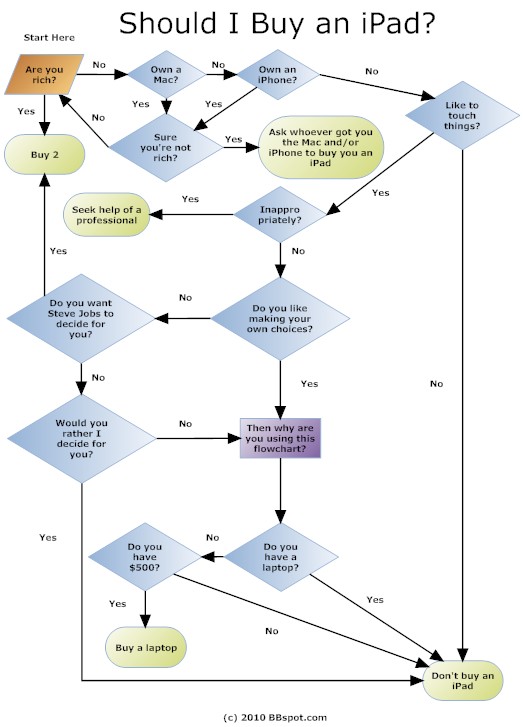
 Me, I'm unimpressed so far. It makes no calls. It's not going to save print, but it IS going to be the hottest fetish device that 'must be seen' on the plane and commuter train. Sure they'll sell a boat load of them and make tons of money. Doesn't mean I want one. I guess it's the non-conformist in me speaking.
It's kind of like this... if all the cool kids get one, and then I get one, I'm just part of the herd. I see it as another semi-useful product being packaged as the 'It' Shinny Product of the month. And if everyone's got one, how cool can it possibly be? And you certainly don't want to be the last one to pick one up. You're the also-ran. I imagine the last guy to get his Member's Only Jacket.
And I'm not mocking Apple. I've bought more than my fair share of Apple products over my consumer life cycle. I was even buying Mac crap in the 90's... when people would ask me if I was brain damaged... (I never did get a straight answer on that question). So it's not that I'm not a Mac Fanboi, far from it. I've simply looked at the product, the specs and I just don't think it's useful enough at that price point. It's a fairly closed system, the lack of a keyboard or stylus kind of pisses me off - so I'm going to 'suffer' with my Motorola Droid.
My Droid has a calorie counter, stopwatch, music player and internet browser. Sure, I probably don't want to read War and Peace on the screen -- but I probably wouldn't on an iPad either. That's me.
Well, actually it might be you too. Here's a handy flow chart.
Mar 12, 2010
The Horrible Truth
Do you have a grocery loyalty card?

 I think it's funny, because I gave them my old Fraternity walk-out name. In retrospect, I wish I had given the name Jeff Lebowski to get my Ralphs Club card.
However, the Costco corporation knows exactly how much coffee I drink and how often I need toilet paper. Which is great for their restocking computer, not so good if that computer becomes self aware - as it will be able to figure out exactly when I'll be sitting on the John.

 I think it's funny, because I gave them my old Fraternity walk-out name. In retrospect, I wish I had given the name Jeff Lebowski to get my Ralphs Club card.
However, the Costco corporation knows exactly how much coffee I drink and how often I need toilet paper. Which is great for their restocking computer, not so good if that computer becomes self aware - as it will be able to figure out exactly when I'll be sitting on the John.
Feb 22, 2010
Pop. The new Tobacco
 California legislators recently pledged to pass a soda tax, and similar proposals have opened up other states. Beverage company lobbyists face an uphill struggle to flatten them all.
After successfully quashing discussion of a federal tax on soft drinks last year, Coke, Pepsi and the fast-food industries may have killed the snake, but 50 new heads just popped out. [pun intended] The States are strapped for cash and see an easy revenue in taxing your soda pop.
In California, they were falling all over each other to pass a tax in light of new study linking soft drink consumption to obesity in children and adults. One study suggests that obesity and related problems cost California alone $41 billion a year in medical expenses and reduced productivity. One can imagine the huffing and puffing behind closed doors? That should have been ours!
So far new taxes on soft drinks have bubbled up in 12 states, including a bill that recently passed the Colorado Legislature. The city of Chicago currently taxes soft drink sales. And the glass. And the Ice....
In Washington, D.C., the Pop industry spent at least $18 million on lobbying and millions more in
 Their strategy has begun to go flat. One of the most prominent organizations, the National Hispanic Medical Assn., has dropped its alliance with the industry, and the California affiliates of two other groups have split from their parent organizations and are considering support for taxes on sweetened soft drinks. Oh oh, they must have seen the bubbles on the wall, or the fat kid in the hall.
Kevin Keane, a senior vice president for the American Beverage Assn., called the tax idea a "money grab" that would hurt working families. "Congress understood that a consumer tax would only add to their pain, not help it," he said. The statement 'duh' echos in my head.
When California Senate Majority Leader Dean Florez (D-Shafter) introduced his soda tax bill, he said one penny of tax per teaspoon of added sugar in any sweetened beverage would generate as much as $1.5 billion each year. That money would pay for parks, recreation and school health programs, Florez said. And, to support that idea, that's 19 cents per can of Coke. He should double it for High Fructose Corn Syrup - and that way we can have the Federal government subsidize the corn production and the States can get it back through their taxes. America... the beautiful... for amber waves of corn...
"The Legislature is primed for this bill," Florez said, adding that he expects bipartisan support. Because, how can you be for fat kids?
 Industry officials say they are voluntarily taking steps to discourage soda overconsumption. For example, the American Beverage Assn. worked closely with First Lady Michelle Obama's "Let's Move" campaign and pledged to prominently display nutrition information on drink containers and vending machines. Foo' American kids can't read!?
"There is no industry in America that has stepped up to do its share to address a complex societal problem like childhood obesity more than the beverage industry," Keane said. Most likely because a tax is the first step before criminal damages and lawsuits start flying. I'm guessing someone around the Pop Association was watching the Big Tobacco cases?
That argument angers public health advocates such as Harold Goldstein, head of the nonpartisan California Center for Public Health Advocacy, which helped Florez craft his bill.
Goldstein sees the beverage industry's voluntary measures as part of "a concerted effort to undermine discussions across the country" about taxing soda. And he was highly critical of the industry outreach to minority groups that suffer most from obesity.
The hard work by Kim Geiger and Tom Hamburger
Now here's the fun part: On one hand, I have to say congratulations to American Legislatures on this one. They've found a product that they don't like: Soda, have found that while it doesn't cause violence, it does strain their budgets in the long term because of obesity and increased wear and tear on their roads. I was going to say sidewalks, but come on. So they've learned to TAX it rather than ban it. Nevermind, as I mentioned earlier that the farmers are getting federal subsidies to grow the stuff in the first place, making soda pop cheaper than water in some places. And if you consider that a Diet Soft Drink has no actual benefit in terms of calories or thirst quenching ability - it's just chemical laden bubble water - and how much energy goes into producing this elixir...
Now in the olden' days, the good ole' days the government would just prohibition the stuff. But they learned with big tobacco, you can still take their money, and publicly shame them at the same time. I really can't believe this didn't happen with Crystal Pepsi. But they're catching up, and they're learning.
Now don't cry too hard for Coke or Pepsi, they've been gearing up for this battle for years. Coke and Pepsi have both been buying and building bottled water, orange juice, sports drinks - and more importantly Energy Drinks to divest their portfolios. And by the time there's a dime tax on your Coke, it'll be about the same time Red Bull is available out of the tap at the McDonald's.
Jan 27, 2010
And Lo, Steve Jobs Presented the Tablets
 Exodus 24:12 And the LORD said unto Steve Jobs, Come up to me into the mount, and be there: and I will give thee tables of chrome and plated aluminum and a multi-touchscreen, and a good battery, and a crippled OS X which I have written; that thou mayest teach them.
Exodus 24:15 And Steve Jobs went up into the mount, and a cloud covered the mount press conference stage.
Exodus 24:16 And the glory of the LORD abode upon mount San Jose, California, and the cloud covered it six days: and the seventh day he called unto Steve Jobs out of the midst of the cloud.
Exodus 24:17 And the sight of the glory of the LORD was like devouring fire on the top of the mount in the eyes of the children of the United States.
Exodus 24:18 And Steve Jobs went into the midst of the cloud, and gat him up into the mount: and Jobs was in the mount forty days and forty nights.
Exodus 31:18 And he gave unto Steve Jobs, when he had made an end of communing with him upon mount San Jose, two tables of testimony, tables of modern shininess, written with the finger of God.
Jan 23, 2010

Nov 27, 2009
Black Friday 2059
 Another day after Thanksgiving - or in every retailer, Black Friday.
Folks went shopping yesterday, and at again at 3:00 AM to get... well, I don't know what they were getting, but it couldn't have been worth it.
Typically, a store offering a shinny trinket for $1.99 off retail will only have two of that particular item, and one of them is almost always broken.
It's not like they're giving it away? Are they? And their strategy is to get you into the store so that you only have time to shop at the one store.
And they still call it "door buster" even after those people died in a Wal Mart store last year.
By shopping on black Friday you are basically valuing money over your time.
If you value your time more than money it is a waste.
If you have more time than money it might make sense to shop then.
If you have more money than time it is a waste. - bg2500
By November 27, 2059, Black Friday camping out had accidentally morphed into a type of adult Easter egg hunt - which had eventually been renamed 'The Turkey Hunt.' It became the last vestige or remnant of American capitalism. It was an easy transition, since African Americans were suing every retailer because of the offensive moniker given to the day. It did not matter that the original name meant that it was the first day a retailer made money that fiscal year... because logic was never the problem - since a persons feelings were hurt, and not hurting someone's feelings was infinitely more important than logic.
The holiday started on the 31st of October, with costumes and candy - and pumpkin decorations to prepare for the Day of the Turkey Hunt. The day before the hunt, a large meal was served, lots of carbs, to get ready for battle. It was the sport of the strong, the tough - the females. They were known as the Lions... since the Lions always played on Turkey Day. Rarely did a male participate. He would sit nervously watching the live feeds from the local stores to see how his wife or daughters fared.
On Turkey Hunt Day, customers would compete by having to scour the stores for the hidden trinket that was featured Pre-Turkey Hunt day announcement. Except that the advertisement was referred to as 'the map.' The CEO of every store dutifully announced the sale items and cryptic clues to the location of each of their store's Golden Pickle. Days, maybe weeks before, retailers would leak clues on their Facebook* and Twitter* (*or their 2059 equivalent) sites dropping hints on where the prized idols might be located. There will be social circles comparing and sharing, and even giving false information as to where the prizes are located. Think Beanie Babies, but in one-on-one, store-to-store basis.
 It was a Golden Pickle - because, thirty years ago, and quite accidentally - The Home OfficeDepot offered a pickle to represent the last decoration placed on the old Christmas tree as their Turkey Hunt item. The Home OfficeDepot explained to their customer base that in old World Germany, it was carefully hidden deep into the tree. And adding to the lore, legend had it that the observant child who found it on the 25th was blessed an entire year of good fortune and a special gift. Because of the significance - and due to the war between Asia and Africa that created an extreme shortage of goods and wears - the HomeOffice Depot staff hid the few pickles it had in stock. They hid them in bags of concrete. It was the hardest Turkey Hunt item to find in the history of the 'sport.' The next year, every single store only offered a single Golden Pickle. No one questioned it after that. The Hunt was on.
When the prize of the box store was found, the bidding wars assembled around Mrs. Indiana Jones as she stood in line. This also became an intricate part of the game. Some of the folks even admitted that they never even looked for the prize; they only lie in wait for the winner to get in line to pay. The bidders offered outlandish compensation for the finder's wares. The second phase sometimes got out of hand, resulting in multiple stabbings until the stores finally had to offer private security for the 'winners.' Some times, the prize changed hands up to twenty times before the winner walked out the door - escorted by her security detail.
The prize, once purchased, elevated in value. It was considered the 'best present' ever, and children or loved ones who received that one gift were guaranteed happiness throughout the year - that is until next year's Winter Solstice Day Celebration...
Behind the curtain, the $1.99 golden pickle had no actual value or fuctionality, and since every store has one - slightly different, with their store logo prominently displayed - eventually only purchasing or achieving an entire collection of ALL the golden pickles from ALL the box stores could an individual achieve total happiness. Subsequently, the idea of giving these items away at the end of the solar cycle became Blasphemous. Which in 2059 meant a bad or poorly executed joke.
Entire industries were created to collect all the previous year's pickles, and from multiple stores. The Christmas trees and bowling trophies of a century ago will be set aside to prominently display the family's pickle collection. Great Grandma's Super Wal-Mart pickle of 2048 became the prize of the last will and testament and was expected to be handed down for generations.
There was also a vast black market for counterfeit pickles. In fact, it was the counterfeits that caused it all to end. When the CVSWalgreen's Pickle Scandal was the top blog story of 2063, it was revealed that there seemed to be more CVSWalgreen's Pickles registered than actual CVSWalgreen's stores... which will be an amazing claim since every other store will be CVSWalgreen's by then. There was an amazing crash that took down the entire financial system, because the entire economy revolved around Turkey Hunt Day and the three month period surrounding it. At once, consumers who flocked to the stores to compete and participate considered staying home... which was devastating! The house of cards were falling. As more people questioned the actual value of their Pickles, eBayWall St. suffered its greatest one-day loss, and with it, the bubble burst.
The three month Pumpkin Turkey Hunt Day for the Solstice Celebration finally hit its peak in America. It was all downhill from there.
Nov 9, 2009
Cute Little Fruit Stickers
 I spent almost all of my day yesterday trying to rebuild my late model Lawnboy recoil starter pulley - because the string frayed off as I was starting her up. After about, oh four hours of tinkering, I came to the conclusion that I'm not a small engine mechanic - and was going to have to rake those leaves by hand.
In the course of setting the lawn and compound up for the winter, I usually reserve some leaves to pile into the garden, and toss some compost on top of it. As I was shoveling my black gold out of my permanent compost pile, I noticed a couple stickers. Yes, they were those cute little fruit stickers that they put on apples and pears to tell you that it's an apple or a pear... sometimes they even tell you useful information like country of origin. Sometimes they'll even inform you they're organic. But not the sticker - The sticker is a chunk of bleached cut-down tree dyed with petroleum based ink using adhesive made from Mr. Ed's ground up hoves and bones. Mildly ironic, no? Welcome to Blasphemes.
But what really caught my attention is that through the process of compost - which is bacteria and rot and worms and heat - a glorious carpiphony of nature - the sticker survived. Hmmm... if that stupid sticker could survive that - I wonder what would happen if you accidentally ate the stupid thing? Maybe it would make it through your digestive juices - maybe it's non-degradable? So after the earth expunges humanity, there will be stainless steel sinks and cute little fruit stickers as a reminder of our existence.
Why would you put a non-degradable sticker directly on something people are eating? They banned all lead in toys - and you're not even 'supposed' to eat that! (They also banned brass in toys, so now every door hinge in America's schools is now illegal - way to go USA)
Later in the day, in a conversation - I was told of a story about a little girl that they thought had serious asthma, and it turned out she had a, wait for it, cute little fruit sticker stuck in her air passage. Then the other discussion at the same table was about a man who's doctors were convinced he had colon cancer - they did a colonoscopy - and guess what they found? Nope, not cancer... Yep. A cute little fruit sticker! Now, granted, these two stories are all hearsay and from a second party talking around a table swapping stories -- but what's the coincidence that I happened to be thinking about this, and then I'm presented by not one, but two anecdotal stories about cute little fruit stickers the same day?
Whoa.
Allow me to offer my solutions to this non-problem that should be a problem:
1) make these labels out of edible products. It wouldn't be hard. Rice paper, soy ink and vegetable gum.
2) Use a laser to burn the skin of the fruit. That'd be awesome. But probably even a small laser would be impractical.
3) Use a branding iron - which can be done in the processing conveyor belt.
There you go gang. And remember - wash your produce, and be sure to take those cute little stickers off before you chomp.
Aug 21, 2009
Old Farts Don't Get It: Why Sears and GM Continue to Fail
 The other day I saw a screen capture of a Sears product page with a suspicious category description (Consumerist).
Sears quickly fixed the error, but the problem was that the entire Sears website was built in a slipshod way that allowed goofballs to mess with the category descriptions. If you've ever messed around with history in wikipedia, imagine the fun you'd have with a whole Sears store!
Everything was fun and games until Sears ordered Conde Nast, owners of Reddit, to delete the post that pointed out their incompetence. With this being the Internet, that just blew up into a whole new level of Sears hatred. Go to Reddit and search for "Sears"
Which leads me to my thought. Old Farts Don't Get It.
Sears could should have left that up there. Except, then they should have personalized it for YOU. Like an Amazon page. If you want the circular blades to be called Big Fuggin' Circles That'll Cut Ya' - cool. That's your personalized site! You've interacted with Sears. Looked at their product. You might have even shared that with your dopey friends. Then they could have logged into their own Baby Grills in the Human Cooking Sections. Now they're having fun, but also looking at the great price of those Craftsman tools and BBQ's. Maybe they'll (shock) buy something?
 But instead, the legal team jumped in front of an opportunity and pissed off the Reddit crowd..."Remember when some Reddit posters organized a boycott of Glenn Beck advertisers and had him thrown off the air? yeah, those were good times."
...and then someone puts that on fark.com too, and suddenly it's on someone's twitter and facebook page, and pretty soon it's here on Blasphemes - followed by a news cast and finally in newsprint the following day. That's the Social Media Revolution in the smallest of nutshells. And Sears just stepped in it.
But Sears has NO idea what that is. Or what could be. Or how to sell or build on it. Hell, they can't seem to attract people into their stores anymore. Or K-mart either. Both companies are joined together now intertwined in a retail death spiral. The combined company, Sears Holding Corp. has just less than the buying power of Wal Mart - but still hasn't figured out how to make that work for them. Instead of adopting the Wal Mart strategy of hub logistics and value pricing they continue to be big, bloated, discombobulated, and dumb. I think it's funny that Wal Mart drank Sears and K-mart's milkshakes... especially since Sears and K-mart invented their brand of retailing!
 One would expect that Sears, which was built on the catalog would have been an early adaptor of the internet and internet sales business models. They should have been buying Amazon in 1994. They could have had bricks and mortar for grandma, and could have linked their inventories to some massive database center in the Sears Tower. Instead, they hired a second rate web guy? I mean, the security hole was that you could change the category values in the URL, and they'd show up on the page. Hey, at least they have a web site. Montgomery Wards refused to get into that whole 'web thing.' Wonder how that worked out for them?
Meanwhile, there's GM. GM is an old fart, wearing a hat, driving slow in the fast lane. And doesn't get it. GM is 101 years old. It's too old and still doesn't understand what is going on either.
GM has actually been bankrupt since 2006 and avoided filing until 2009 thanks to the backs of banks and bondholders who propped it up by profitable car loans. Their management team that got booted by Obama came from finance, not vehicle design.
They also made pretty crappy cars. They couldn't compete with Toyota. Toyota ate their whole lunch. They also ignored Toyota and Honda. Except for the Saturn, but they let that get fat and bloated too. They failed to innovate. Why bother? All the money was in financing.
But I think their biggest failure was that they failed to win over the Gen Xers. There was never a discussion or marketing, or that 'one cool ass car' that got the Gen X American kids interested in GM. They LET those customers walk out of the dealerships. Those customers discovered and became loyal to GM's competitors. Once a customer took the test drive, why would you go back to a GM?
 Look, even the staunchest Made In The USA folks I know have finally conceded, and now will never buy another GM car. It's over. And even these guys can justify their new Hondas and Toyotas by rattling off all the manufacturing plants -- in America. Their only regret is that the management in Japan is making all the money. I stop them right there and explain that good management deserves ever dollar that they earn.
And why they'll fail again? GM has had no dialogue with Gen X. So far, they don't seem too interested in Gen Y either... Wonder if they'll get enough bail outs to last that long that this misstep will even matter?
But GM getting a Twitter account isn't going to suddenly turn their fortunes around - but they did try selling cars on eBay not too long ago. How's that working out?
The thing is, Sears/K-mart and GM are examples of Old School Big Business. Big, bloated, over confident, more managers than innovators, management that is risk averse and is incapable of understanding or working in the current market conditions.
See you in the history books! Well.... bye!
Jun 26, 2009
Rolling Stones Sell Out
Way, way, a long time ago... the Rolling Stones sold out to shell
Rice Krispies?
Rice Krispies?
Subscribe to:
Posts (Atom)