

Impious since 2006
Showing posts with label Santa. Show all posts
Showing posts with label Santa. Show all posts
Dec 24, 2017


Dec 26, 2016

Dec 21, 2016
Hipster Nativity 2016

Dec 8, 2016
The War on Christmas

Poor Poor Rudolph. Wrong place, wrong time.
I do wonder why Rudolph was in Aleppo. Reconnaissance?
Sep 12, 2011
Weeping Santa Jesus
I just found this:
“Remembering” by Fran Lagana-Brooks. From the “Weeping Santa” collection.
 All I can think of when I see Super giant Jesus comforts weeping Santa, damn it - we haven't even had Halloween yet, people! Also, notice Jesus didn't leave any foot prints - walks on water, whether frozen or liquid.
“Remembering” by Fran Lagana-Brooks. From the “Weeping Santa” collection.

Dec 27, 2010
Dec 24, 2010

An Atheist Grand Plan
 I had planned on writing a massive manifesto of how I'm planning to allow the children in my life to be completely indoctrinated into the mythology of Santa Claus. Hook. Line. Sinker. The magic of spying on them at all hours -- I even plan on using this in July just to keep them on their toes... and to eliminate some of that low pitched whine in their engines.
I figure that once they turn about 7 or 8, they'll question the physics of a fat man in a red suit stopping time and the aerodynamics of flying reindeer. At the very least, the economics of how he somehow manufactures toys and delivers them for nothing more than a handful of stale cookies. How, exactly, does he compete with the Chinese? They've got to be killing him with labor expenses.
I have decided that when a child asks me if Santa is real - I won't just leap out of my chair and tell them. No, it'll be much more nuanced. I'll make the child make his or her case. I'll even toss out the, "Faith" and "Belief" and "I can't prove it, but I believe it..." arguments. In fact, I should probably look up some classic debates to debunk evolution to prepare. Maybe I'll even bust out a picture of Santa on a dinosaur? Nah, that's just cruel.
After a test of faiths - I'll mention the number of people keeping up the lie. Frank Sinatra, pop stars, even Bruce Springsteen are in on the conspiracy. How many businesses are making fist loads of money in Santa's name? How many versions of Santa are there - what are the variances from culture to culture -- or hell, even the different ABC Family cartoon specials?
With just a tiny bit of skill, the lad asking the tough questions may also make the connection to organized religion.
That's my goal, anyway. Ought to save those kids countless hours sitting in church and thousands of dollars.
Dec 18, 2010

Dec 16, 2010
Dec 25, 2009
Thanks Santa!

Well, I hope you all got what you wanted this Christmas. I did.
Looks like that Official Red Ryder Carbine-Action Two-Hundred-Shot Range Model Air Rifle got upgraded! Now I'm ready for the Zombie Apocalypse with my new Red Ryder Peacemaker 2010!
Dec 24, 2009


Dec 23, 2009
Gift Giving
 Christmas is the time when capitalism goes uncloaked, when alienation blossoms, when much of the world succumbs to a frenzied potlatch of one-upmanship, debt, and disappointment.
Gift giving in general is obviously linked to the Magi's visit to the Baby Jesus. But, actually, giving gifts at the time of the solstice and the Romasn strenae (New Year) was customary way beforehand. The typical gifts were honey, fruits and lamps... but if you were rich, you were expected to give gold coins as per the tradition of the Roman Saturnalia.
Like many old customs, gift exchange was difficult to get rid of even as Christianity spread and gained official status in the Empire. Early church leaders tried to outlaw the custom, but people want what's coming to them, so it stuck. Which forced church leaders to conjure up a Christian justification for the practice. The justification was found in the Magi’s act of bearing gifts to the infant Jesus, and in the concept that Christ was a gift from God to the world, bringing in turn the gift of redemption and everlasting life. That's weaker than my grandfather's decaf coffee.
 But the real explosion of gift giving, wrapping paper and all those customs we hold dear without actually questioning really gets going in Victorian England. The Victorians, who brought a renewed warmth and spirit to Christmas after it had experienced a long period of decline, made the idea of family part of the celebration. Friendliness and charity filled many hearts during their Christmas season, so giving gifts was natural. The ultimate reason for giving a gift was as an expression of kindness, a sentiment that went nicely with the historical tradition of the holiday. Damn Dickens.
The American Christmas was immediately copied, gift giving, traditions and all. America expanded on the concept with the addition of Santa Claus. The association with gifts was a natural one. Soon a funny little elf with flying reindeer (or one of his earlier models) would take responsibility for trinkets left in an ever-increasing number of stockings.
He has many names, in many customs. Father Christmas, also known as Santa Claus, Père Noël, and the Weihnachtsmann; Saint Nicholas or Sinterklaas; the Christkind; Kris Kringle; Joulupukki; Babbo Natale; Saint Basil; and Father Frost.
However, the lavish Americanized version of Christmas gift giving is relatively new to the traditions, and it comes with the commercialization of the entire month. The most famous and pervasive of these figures in modern celebration worldwide is Santa Claus, a mythical gift bringer, dressed in red, whose origins have diverse sources. The name Santa Claus is a corruption, perhaps a mispronouncing, of the Dutch Sinterklaas, which means simply Saint Nicholas. Nicholas was Bishop of Myra, in modern day Turkey, during the fourth century. Among other saintly attributes, he was noted for the care of Children, generosity, and the giving of gifts. His feast on the 6th of December came to be celebrated in many countries with the giving of gifts. Saint Nicholas traditionally appeared in bishoply attire, accompanied by helpers, and inquired about the behavior of children during the past year, before deciding whether they deserved a gift or not. By the 13th century Saint Nicholas was well known in the Netherlands, and the practice of gift-giving in his name spread to other parts of central and southern Europe. In the Reformation, many Protestants changed the gift bringer to the Christ Child or Christkindl, (corrupted in English to Kris Kringle), and the date of giving gifts changed from December the 6th to Christmas Eve.
 The modern popular image of Santa Claus, however, was created in the United States, and in particular, in New York. By Don Draper. Well, not him specifically, but you get the reference. Six people including Washington Irving and the German-American cartoonist Thomas Nast can be counted as part of the team. After the American Revolutionary War, New Yorkers were looking for symbols of their non-English past. Since they were established by Dutch colonials, and was once called New Amsterdam the Dutch Sinterklaas tradition seemed a good place to start. Of course, they weren't totally happy with it, and in a committee reinvented Sinterklass into Saint Nicholas. In 1809, the New-York Historical Society convened and retroactively named Sancte Claus the patron saint of Nieuw Amsterdam (yeah, that's the Dutch name for New York City).
In 1810, Santa Claus was drawn in bishops' robes. However as new artists took over, Santa Claus developed more secular attire. Nast drew a new image of "Santa Claus" annually, beginning in 1863. He was kind of creepy and elfish. By the 1880s, Nast's Santa had evolved into the robed, fur clad, form we now recognize, perhaps based on the English figure of Father Christmas.
Santa Claus is famous around the world for giving gifts to good children. And so is Father Christmas. Pssst. They're the same dude.
Father Christmas, a jolly, well nourished, bearded man who typified the spirit of good cheer at Christmas, predates the Santa Claus character. He is first recorded in early 17th century England, but was associated with holiday merrymaking and drunkenness rather than the bringing of gifts. Hey, he is British after all. In Victorian Britain, his image was remade to match that of Santa. How's that for a feedback loop? The French Père Noël evolved along similar lines, eventually adopting the Santa image. In Italy, Babbo Natale acts as Santa Claus, while La Befana is the bringer of gifts and arrives on the eve of the Epiphany. It is said that La Befana set out to bring the baby Jesus gifts, but got lost along the way. Now, she brings gifts to all children. In some cultures Santa Claus is accompanied by Knecht Ruprecht, or Black Peter. In other versions, elves make the toys. His wife is referred to as Mrs. Claus.
But wait, what about his iconic red suit and superpowers? That starts with the Coca Cola Company. And that one little Irving poem.
The Coca-Cola Company began its Christmas advertising in the 1920s with shopping-related ads in magazines like The Saturday Evening Post. The first Santa ads used a strict-looking Claus, in the vein of Thomas Nast. But, for the record, Nast had introduced the red furs over green before Coke contracted Santa for an endorsement deal.
But why would Coke spend all that money on Santa? Up until then, folks treated Coke as a drink only for warm weather. The Coca-Cola Company began a campaign to remind people that Coca-Cola was a great choice in any month, and with every meal. This began with the 1922 slogan "Thirst Knows No Season," and continued with a campaign connecting a true icon of winter -- Santa Claus -- with the beverage. Brilliant.
In 1930, artist Fred Mizen painted a department store Santa in a crowd drinking a bottle of Coke. The ad featured the world's largest soda fountain, which was located in the department store of Famous Barr Co. in St. Louis, Mo. Mizen's painting was used in print ads that Christmas season, appearing in The Saturday Evening Post in December 1930. It snowballed from there. Pretty soon kids were sending their letters to Coca-Cola HQ rather than the Dead Letter Office.
 From what I can tell, most of the other superpowers and background stories only come from the songs, Miracle on 34th Street, and the Rankin/Bass CBS specials. Rudolph was created for Montgomery Wards.
At this point, Santa has more superpowers than late 1970's Superman. But that's the American Santa...
Current tradition in several Latin American countries (such as Venezuela and Colombia) holds that while Santa makes the toys, he then gives them to the Baby Jesus, who is the one who actually delivers them to the children's homes, a reconciliation between traditional religious beliefs and the iconography of Santa Claus imported from the United States. Because that makes SO much more sense.
In Alto Adige/Südtirol (Italy), Austria, Czech Republic, Southern Germany, Hungary, Liechtenstein, Slovakia and Switzerland, the Christkind (Ježíšek in Czech, Jézuska in Hungarian and Ježiško in Slovak) brings the presents. The German St. Nikolaus is not identical with the Weihnachtsman (who is the German version of Santa Claus). St. Nikolaus wears a bishop's dress and still brings small gifts (usually candies, nuts and fruits) on December 6 and is accompanied by Knecht Ruprecht. Although many parents around the world routinely teach their children about Santa Claus and other gift bringers, some have come to reject this practice, considering it deceptive.
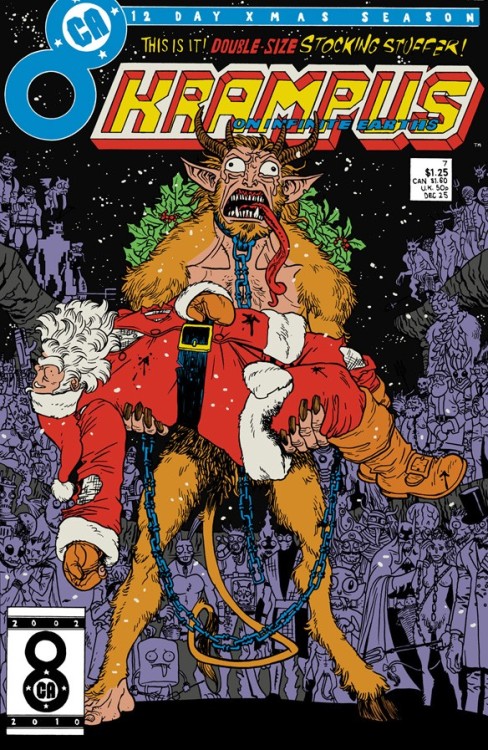
 And then there's The Krampus! In parts of Austria, Krampus is a scary figure, most probably originating in the Pre-Christian Alpine traditions. Local tradition typically portrays these figures as children of poor families, roaming the streets and sledding hills during the holiday festival. They wore black rags and masks, dragging chains behind them, and occasionally hurling them towards children in their way. These Krampusumzüge (Krampus runs) still exist, although perhaps less violent than in the past.
Today, in Schladming, a town in Styria, over 1200 "Krampus" gather from all over Austria wearing goat-hair costumes and carved masks, carrying bundles of sticks used as switches, and swinging cowbells to warn of their approach. They are typically males in their teens and early twenties, and often get very drunk. Awesome. They roam the streets of this typically quiet town and hit people with their switches. It is not considered wise for young women to go out on this night, as they are popular targets.
In many parts of Croatia, Krampus is described as a devil, wearing chains around his neck, ankles and wrists, and wearing a cloth sack around his waist. As a part of a tradition, when a child receives a gift from St. Nicolas he is given a golden branch to represent his/hers good deeds throughout the year; however, if the child has misbehaved, Krampus will take the gifts for himself and leave only a silver branch to represent the child's bad acts. Children are commonly scared into sleeping during the time St. Nicolas brings gifts by being told that if they are awake, Krampus will think they have been bad, and will take them away in his sack. In Hungary, the Krampusz is often portrayed as mischievous rather than evil devil, wearing a black suit, a long red tongue, with a tail and little red horns that are funny rather than frightening. The Krampusz wields a Virgács, which is a bunch of golden coloured twigs bound together. Hungarian parents often frighten children with getting a Virgács instead of presents, if they do not behave. By the end of November, you can buy all kinds of Virgács on the streets, usually painted gold, bound by a red ribbon. Getting a Virgács is rather more fun than frightening, and is usually given to all children, along with presents to make them behave.
Why the hell hasn't the Krumpus been brought to America? It's got public drunkeness, beating and kidnapping of little bratty kids - and he's more hideous than Freddy Kruger! Maybe Halloween town was fighting over rights issues. It's a messy contract dispute.
Dec 20, 2009
Stockings
 Christmas stockings are hung near the chimney on Christmas Eve for Santa Claus to fill it with goodies. It is an empty sock or a bag that is given the shape of a sock. The children in United States and some other countries have been following this tradition of hanging a Christmas stocking, believing that Father Christmas will fill it with sweets and gifts for them. The items that are believed to be stuffed in the Christmas stocking by Santa Claus are known as stocking stuffers. They're at the front door of your local Target store, in the bins marked One Dollar.
The tradition of the Christmas stockings apparently began by a silly little story about a kind noble man who had three daughters. The wife of the nobleman had died off and the daughters and their father were left in a state of sorrow. The daughters had to do all the work in the house. When the daughters became young and eligible for marriage, the poor father could not afford to give the huge dowries to their husbands.
 One evening the daughters, after washing their stockings hung them near the fire place to be dried. Santa Claus being moved by the plight of the daughters came in and put in three bags of gold one in each of the stocking hanging by the chimney. The next morning the family noticed the gold bags and the nobleman had enough for his daughter’s marriage. The daughters got married and they lived happily ever after. Since the story, children have been hanging Christmas stockings. Not surprisingly. This also explains about 72% of all the gold coins sold around the Solstice - the other 18% going toward Dradle wagers.
Some say the Dutch introduced the Christmas stocking to America. It was told that during the 16th Century, children in Holland would leave their clogs by the hearth filled with straw for the reindeer (or "donkey"). Oops another significant translation error.
A treat for Santa was left in the house near the fire. In return "Sinterclass" would leave the children treats. Later the clogs would become stockings, and the Saint known to all would become "Santa Claus."
 But here's the take away - Christmas stockings are supposed to have the gifts given by Santa Claus. The other gifts are wrapped in present papers and placed near the Christmas tree were from, you know, real people. It is believed that a child who misbehaves during the year will not get a gift in their Christmas stocking. Or will get coal... but considering until the mid 1950's, coal was still a pretty good gift. The Christmas stockings are traditionally hung on the fireplace. But as most of the modern homes do not have a fireplace, any location is suitable for hanging the Christmas stockings. In many traditions the Christmas stocking is to be stuffed by a gift that will stimulate the five senses. Oranges, candy and Official Red Ryder Carbine-Action Two-Hundred-Shot Range Model Air Rifles. The gift given by Santa Claus would be something to eat, a thing that makes a sound and gives a pleasant view to the eyes or gift which has a lovely fragrance. Gunpowder is more of a surfer kind of stink, but it's pleasant.
In the present modern culture there are special Christmas stockings available in the market. Like Dora the Explorer, Cars, and whatever licensed property you might enjoy. I'd prefer an A-Team stocking. Some families design unique stockings for each family member. In Puerto Rico, children put flowers and greens in small boxes and place them under their beds for the camels of the Three Kings; Italian children leave their shoes out the night before Epiphany, January 5, for La Befana the good witch; and in France, the children place their shoes by the fireplace.
Dec 18, 2009
Team Santa
 Team Santa
Dec 15, 2009

Dec 9, 2009

Dec 8, 2009

Subscribe to:
Posts (Atom)