

Impious since 2006
Showing posts with label facts. Show all posts
Showing posts with label facts. Show all posts
Jan 23, 2017


Jun 15, 2010

Dec 29, 2009
Never Tell Me the Odds
 Security theater consists of security countermeasures intended to provide the feeling of improved security while doing little or nothing to actually improve security. The term was coined by Bruce Schneier for his book Beyond Fear, but has gained currency in security circles, particularly for describing airport security measures. It is also used by some experts such as Edward Felten to describe the airport security repercussions due to the September 11 attacks. Security theater gains importance both by satisfying and exploiting the gap between perceived risk and actual risk.
Security theater has been defined as ostensible security measures which have little real influence on security whilst being publicly visible and designed to demonstrate to the lesser-informed that countermeasures have been considered. Security theater has been related to and has some similarities with superstition.
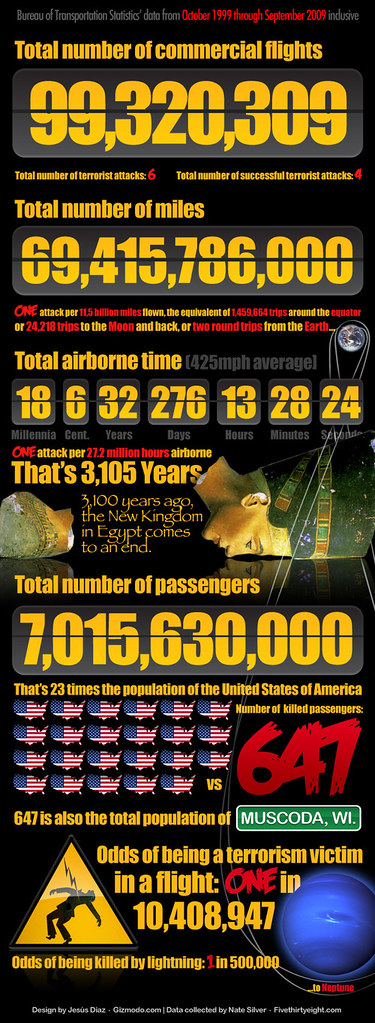 Thanks Gizmodo for the pic and the facts
Nov 11, 2009
HFCS Increases Hypertension Risk by 87%
 Our good friends at Science Daily are reporting that a diet high in fructose increases the risk of developing high blood pressure (hypertension), according to a paper being presented at the American Society of Nephrology's 42nd Annual Meeting and Scientific Exposition in San Diego, California. The findings suggest that cutting back on processed foods and beverages that contain high fructose corn syrup (HFCS) may help prevent hypertension.
Today, Americans consume 30% more fructose than 20 years ago and up to four times more than 100 years ago, when obesity rates were less than 5%. While this increase mirrors the dramatic rise in the prevalence of hypertension, studies have been inconsistent in linking excess fructose in the diet to hypertension.
I'd just like to say that I'm pleased that science is finally taking a gander at the fat and sugary diets that we're ingesting.
Meantime, here are some graphs that I've been meaning to post for a while...


Jul 19, 2009
Golden Food Market Shootout Update
 So I cutn'pasted an exclusive interview with the gun owner who saved lives in the Richmond Golden Market shooting last week. Here's the follow up story:
On Friday I received a surprise call from the gun owner who has been in the press this week for saving lives at a Richmond store. The gun owner used a replica 1875 Remington Army .45 Long Colt with a 7 1/2 inch barrel to stop a criminal who had shot the store's owner.
He wanted to remain anonymous, but called so that the story could be set straight, as much of what was in the press wasn't accurate. Probably also the Blasphemes story.
Board member Dennis O'Connor and I ended up meeting with him at the Golden Market store, where the shooting had taken place one week earlier.
Besides being able to actually see the layout of the store, Dennis and I got to see the security videos of the shooting!
We also got to meet the store owner who had been shot twice during the hold up, but is now back at his store.
Here is what we know from talking to the gun owner and watching the videos:
The gun owner (A.K.A. White Hat, because he's one of the good guys) was in the store waiting in line to pay for an item when the bad guy (A.K.A. Black Hat, because he's a scum sucking villain) came in wearing dark sunglasses and trying to coverup his face while brandishing a revolver. The Black Hat yelled for everyone to get down and before anybody could react, immediately walked over to the store owner and in a cold-blooded fashion shot him twice. The owner then dropped down behind the counter. It wasn't more than 2 seconds after the Black Hat first walked in the doors that he shot the store owner.
Those shots at the store owner missed a teenage boy's head by inches.
The White Hat yelled for the Black Hat to drop his gun as the White drew his gun. Black opened fire on the. White returned fire, hitting Black as White dove hard for the floor behind some barrels full of ice and drinks.
Black Hat ran towards the back of the store, aiming his gun at an innocent man laying prone on the floor. Luckily Black Hat was too distracted by White Hat to shoot the man. There is no doubt in my mind that the man would have been shot in cold blood that day if it weren't for White Hat returning fire.
Black Hat kept trying to get to the front of the store by walking up various aisles and firing shots at the White Hat as he did so. At one point cans of tinned meat exploded on a shelf as Black took a shot at White Hat.
What was bizarre was that Black actually was strutting around like he owned the place while under fire! As he approached the front of one aisle, he again pointed a gun at a person on the ground and was about to execute him, when he was again distracted by White Hat.
Finally White Hat spotted Black Hat at the front of an aisle standing in the open.
Much to his surprise, White discovered that when he dove hard for the floor he had somehow broken the trigger on his gun!
 But the gun was a single action, so White pushed himself up with one arm, aimed the gun, pulled the hammer back and let it fly forward - twice.
Although seriously wounded three times, Black Hat came at White Hat. Black tried to grab White's gun since Black was out of ammunition. A life-and-death struggle began. White got a grip on Black's gun and White hit Black, twice, hard on the temple with the 7 1/2" barrel on his rather heavy gun.
Black Hat finally broke off the engagement, tried to run out the front door, but collapsed at the door.
White secured Black's gun and keeping an eye on the now unconscious bad guy, called 9-1-1.
Black Hat has now died (he was in critical condition since the shooting).
The police showed up a minute or so after the 9-1-1 call and initially had everyone in the store at gun point and handcuffed some until they could figure out who was who.
What really impressed me was that on the surveillance video, the owner, while shot twice by Black Hat, was walking around making sure that all of his customers were OK after the shooting had ended. He only let himself collapse after he was sure they were OK! Words fail me on this. I am so glad that he made it. What a dichotomy - Black Hat who shoots an innocent person without provocation, almost killing a teenager while doing so - caring for no one but himself. And then the store owner who, while seriously wounded, making sure his customers were OK. Evil exists and so does Good. Both were on display in those two minutes of terror. Luckily only the bad guy was killed. The owner was walking with a limp, clearly in some pain.
A lot of people owe their lives to White Hat. However, he is having none of it, saying that he simply did what he had to do.
--
The White Hat wanted me to share the following points:
* Buy a quality gun - don't use some cheap $90 gun to protect your life. He considered his gun to be a good one and even then the trigger broke under the extreme stress of a life-and-death battle.
* Practice with your gun, get training, and be good with that gun.
* More and more Black Hats are choosing to kill in cold blood to get what they want. If they can't live the "good life, " then they don't care if their crimes send them to jail.
* He also noted that fewer and fewer Black Hats are getting any jail time.
Here are my thoughts from watching that tape:
* Talk about a cold-blooded, fast attack where an innocent was shot without warning! Unbelievable. Situational awareness is really important. Luck doesn't hurt, either.
* Open carry was an advantage in this case because in the video I saw just how fast White Hat managed to draw his gun and begin to return fire. You always hear about how open carry is so bad tactically - you'll be the first one shot, etc. Oh, yeah? White Hat had a HUGE gun in plain sight and he was NOT shot. Who got shot first? An unarmed store owner.
* I am betting that the Black Hat was on drugs, big time. He was hit with THREE 45-CALIBER BULLETS, with at least two of those hits causing grievous injury, and he continued the fight as if he had not even been hit at all! In fact he was strutting like a peacock who owned the place as he was walking up and down the aisles trying to get to a position where he could shoot White Hat. As a gun owner, you need to be prepared for that eventuality and keep shooting the bad guy in his center of mass until he stops his attack. Don't think one shot, or even two shots, are going to do it. And a head shot might well be what it takes to stop such an attack quickly.
* If you are out of ammunition, a gun does make a great weapon with which to bludgeon someone in hand-to-hand combat.
* This shooting bolstered both sides of the argument about how much ammunition one should carry. The good guy got off only four shots (of course his gun had a broken trigger and that didn't help). The bad guy got off six shots and ran out of ammunition (thankfully). But in my mind, and having had some advanced training, I think an extra magazine for a semi-auto, or a reloader for a revolver, is a good idea. With someone like Black Hat above, if you run out of ammunition before he does, he will execute you. Period.
--
This exclusive came to us from Philip Van Cleave who is the president of Virginia Citizens Defense League. http://www.vcdl.org/
PS - the pictures are of Roy Rogers and some random villain found on Google Image search. The two illustrations are meant for allegory only.
Jul 9, 2009
Eye of the Needle
"The eye of a needle" is part of a phrase attributed to Jesus by the synoptic gospels:
- ...I tell you the truth, it is hard for a rich man to enter the kingdom of heaven. Again I tell you, it is easier for a camel to go through the eye of a needle than for a rich man to enter the kingdom of God.
The parallel versions appear in Matthew 19:23-24, Mark 10:24-25 and Luke 18:24-25.
 The saying was a response to a young rich man who had asked Jesus what he needed to do in order to inherit eternal life. Jesus replied that he should keep the commandments. To which the man stated he had done. Jesus responded, "If you want to be perfect, go, sell your possessions and give to the poor, and you will have treasure in heaven. Then come, follow me." The young man became sad and was unwilling to do this. Jesus then spoke this response, leaving his disciples astonished.
Another common explanation of the figure, is that Jesus was referring to a certain gate in Jerusalem called Needle's Eye. This entry-point was built like the eye of a needle and so low that a camel could pass only if it entered kneeling and unencumbered with baggage. The lesson would then be that an eternal inheritance awaits those who unburden themselves of sin, and in particular, the things of this world.
Also, kneeling represents submission and humility, which are required to enter into heaven. Although there is no historical evidence that such a gate ever existed, through frequent repetition the idea has attained the status of virtual dogma in some circles.
The Jaffa Gate in the wall of Jerusalem, showing the 'Needle's Eye.' Small doors such as this were common features of the gates of ancient cities; humans could pass through fairly easily, but large animals, such as camels, had to be unloaded and then had to kneel to get through, even then with difficulty."
That, or capitalists are totally hosed. Either way, it was an interesting point that I learned today.
Jun 11, 2009

Jun 9, 2009
How to Win a Religious Debate
 William Tyndale (sometimes spelled Tindall or Tyndall) (c. 1494 – 1536) was a 16th-century Protestant reformer and scholar who, influenced by the work of Desiderius Erasmus and Martin Luther, translated the Bible into the Early Modern English of his day. Tyndale was the first English translation to draw directly from Hebrew and Greek texts, and the first to take advantage of the new medium of print, which allowed for its wide distribution. In 1535, Tyndale was arrested on the orders of King Henry VIII, jailed in the castle of Vilvoorde outside Brussels for over a year, tried for heresy and burned at the stake. He was strangled before his body was burnt.
He's the guy who wrote the English Bible.
Much of Tyndale's work eventually found its way into the King James Version (or "Authorised Version") of the Bible, published in 1611, which, as the work of 54 independent scholars revising the existing English versions, drew significantly on Tyndale's translations.
In translating the Bible, Tyndale introduced new words into the English language, and many were subsequently used in the King James Bible:
- Jehovah (from a transliterated Hebrew construction in the Old Testament; composed from the Tetragrammaton YHWH.
- Passover (as the name for the Jewish holiday, Pesach or Pesah),
- Atonement (= at + onement), which goes beyond mere "reconciliation" to mean "to unite" or "to cover", which springs from the Hebrew kippur, the Old Testament version of kippur being the covering of doorposts with blood, or "Day of Atonement".
- scapegoat (the goat that bears the sins and iniquities of the people in Leviticus, Chapter 16)
- let there be light
- the powers that be
- my brother's keeper
- the salt of the earth
- a law unto themselves
- filthy lucre
- it came to pass
- gave up the ghost
- the signs of the times
- the spirit is willing
- live and move and have our being
- fight the good fight
Some of the new words and phrases introduced by Tyndale did not sit well with the hierarchy of the Roman Catholic Church, using words like 'Overseer' rather than 'Bishop' and 'Elder' rather than 'Priest', and (very controversially), 'congregation' rather than 'Church' and 'love' rather than 'charity'. Tyndale contended (citing Erasmus) that the Greek New Testament did not support the traditional Roman Catholic readings.
Contention from Roman Catholics came from real or perceived errors in translation. Thomas More commented that searching for errors in the Tyndale Bible was similar to searching for water in the sea, and charged Tyndale's translation of Obedience of a Christian Man with having about a thousand falsely translated errors. Bishop Cuthbert Tunstall of London declared that there were upwards of 2,000 errors in Tyndale's Bible. Tunstall in 1523 had denied Tyndale the permission required under the Constitutions of Oxford (1409), that were still in force, to translate the Bible into English.
In response to allegations of inaccuracies in his translation in the New Testament, Tyndale wrote that he never intentionally altered or misrepresented any of the Bible in his translation, and would never do so.
While translating, Tyndale followed Erasmus' (1522) Greek edition of the New Testament. In his Preface to his 1534 New Testament ("WT unto the Reader") he not only goes into some detail about the Greek tenses but also points out that there is often a Hebrew idiom underlying the Greek. The Tyndale Society adduces much further evidence to show that his translations were made directly from the original Hebrew and Greek sources he had at his disposal. For example, the Prolegomena in Mombert's William Tyndale's Five Books of Moses show that Tyndale's Pentateuch is a translation of the Hebrew original.
Meaning, his is the closest to the original text from all the other authors... except that he added some much needed flair.
Be sure to break this article out for your next Jehovah's Witnesses - they really like to tell you that the Bible is directly from God's lips to the page. You tell 'em, nope - Bill Tyndale's.
Jun 7, 2009
Food Inc. Doc.
Fast Food Nation, the best-selling book by Eric Schlosser, exposed the seamy side of the all-American meal. A documentary follow-up of sorts, Food Inc., goes further back in the food chain to show how animals are raised in squalor, slaughtered en masse, bathed in ammonia and served to us with a "Farm fresh" label. Let's just say brands like Tyson, Perdue and Smithfield don't fare so well in this independent film, opening in New York and Los Angeles on June 12 from Magnolia Pictures.
The companies' advertising can try to keep spinning the pastoral fantasy, but anyone who sees this film won't be swallowing that notion anymore. (None of the marketers, who control the majority of food production in the U.S., would appear in the doc.) Monsanto, the chemical company responsible for Agent Orange, might take it on the chin the hardest, as filmmaker Robert Kenner follows the plight of some small farmers who dared to stand up to the DDT-maker-turned-agribusiness. Guess how that turned out?
Yes, yes. Meat is murder... However, the other side of this coin is whether anyone bothered to ask "Why?" Why has food become mechanized? "Evil?" What are the end results? Are people eating and not starving? Are we past subsistence farming - and how much more? Are fewer people needed to toil the land to feed the rest of us so that we can all concentrate on stepping up the grand Maslow's Pyramid? It may have become more about marketplace and greed, but the original goal was to modernize the business of agriculture.
And, correct me if you can find other evidence, wasn't the entire Industrial Revolution was based upon making our lives toiling in the agrarian industry just a little easier?
Perhaps there's a middle ground of discovering how your food is made and shrink wrapped, and what alternatives we might have - and also a frank discussion of costs. Would beef be a couple hundred dollars a pound if it was all free range grass feed in the great state of Oklahoma and walked to the Chicago slaughter houses like in 'the good-ole days?' How many people in the inner cities would die of starvation because a hand full of people didn't like the industrial process that chops the heads off of live chickens and then turns them into nuggets? Must we all grow vegetables on top of our garages and edible flowers in our front yards while we recycle our urine into dandelion wine? Isn't that the same kind of intolerance that you'd expect from that guy listening to Rush Limbaugh holding up the line at the KFC drive thru window? I'm all for a change - but let's be realistic about it.
What's the end game, and what is the compromise? You tell me?
Apr 28, 2009
The Facts
Mexican Flu / Swine Flu: Top 21 Answers You Need to Know
 With more outbreaks of the new strain of swine flu come outbreaks of misinformation and rumor.
Twitter is proving to be notorious for spreading false information.
The following are 21 questions answered by infectious disease expert Charles Ericsson, M.D., professor of internal medicine and director of Travel Medicine at The University of Texas Medical School at Houston.
Also, Robert Emery, DrPH, vice president for Safety, Health, Environment & Risk Management at UT Health Science Center and associate professor in the UT School of Public Health explains common sense preparedness and prevention of illness.
1. How do symptoms of swine flu differ from other types of flu?
None, really, although this flu might include gastrointestinal symptoms (diarrhea and vomiting), as well as the usual respiratory symptoms. The basic symptoms for swine flu are similar to the seasonal flu we are vaccinated for each year, which may include:
- Fever (greater than 100°F or 37.8°C)
- Sore throat
- Cough
- Stuffy nose
- Chills
- Headache and body aches
- Fatigue


You wouldn't really, nor would your physician know for sure without a respiratory specimen taken within the first 4-5 days. The specimen would then be sent to the US Centers for Disease Control and Prevention (CDC).
The cases so far in the US have been relatively mild compared to the illness described in patients in Mexico. We do not yet know why the US cases have been milder.
The important point is to call your doctor if you think you have the flu. Prescription anti-viral drugs such as TamiFlu or Relenza can be called in by your doctor. Unless you are:
- exceptionally ill with flu-like symptoms
- are chronically ill
- immune-suppressed
- quite elderly
- or have a very young child, under age 2
3. How long are people contagious?
Adults are potentially contagious for the length of time one has symptoms, up to 7 days following the beginning of illness. The “shedding stage” of the virus is during the first 4-5 days of illness. Children can be considered contagious longer, up to 10 days. The initial incubation period is 24-48 hours.
4. Is there medication for this?
Yes, Tamiflu or Relenza have shown to be effective against these recently reported strains of swine flu. Altogether, there are four anti-viral drugs that we commonly use to treat various strains of flu.
5. Can I start taking medicine for it now, just in case I get it later?
That is not presently advised. Preventative medication might be advised for very special circumstances where a person had to expose themselves to potentially ill people during an epidemic (which we do not yet have here). Such people might include ER workers. An outbreak in a nursing home, for instance, might lead to protecting all the other residents with a drug like TamiFlu.
For the general public, the current answer is no to prophylactic (preventative) use with anti-viral medications. Its coverage time is limited.
Do not confuse over-the-counter “cold and flu” preparations for anti-flu medications that require a prescription.
6. Are the symptoms in children different from adult symptoms?
Though the basic symptoms are similar, the signs of potentially life-threatening complications differ.
The CDC advises those with these symptoms to seek emergency care immediately:
Emergency warning signs in children are:
 Fast breathing or trouble breathing
- Bluish skin color
- Not drinking enough fluids
- Not waking up or interacting
- Being very irritable
- Fever with a rash

- Difficulty breathing or shortness of breath
- Pain or pressure in the chest or abdomen
- Sudden dizziness
- Confusion
- Severe or persistent vomiting
Not yet, but the CDC has this current strain of virus and will consider whether to add it to next year’s flu vaccine as time goes on.
8. If I took the swine flu vaccine in the swine flu scare during the 70s, would that cover me? What about this year's flu shot I just took?
We don’t know yet. Previous vaccines could be expected to afford only partial, incomplete protection at best.
This new strain of the swine flu virus (H1N1) actually has a mixture of swine and avian components (not to be confused with the deadly avian flu of Southeast Asia).
9. Can I catch it from pigs?
No. This strain is one that is communicable through human-to-human contact. It is a mutated form of a swine virus.
 10. Can I catch it from eating pork?
Absolutely not! Swine flu is not transmitted by food. It is not a so-called foodborne illness. Bacon, ham and other pork products are safe to eat, assuming they are prepared properly. An internal temperature of 160 degrees for cooked meat will kill any bacteria or virus.
Swine flu is transmitted by airborne droplets from an infected person’s sneeze or cough; or from germs on hands, or germ-laden surfaces. Eating pork will not give you swine flu any more than eating chicken will give you bird flu.
11. How does it cross from a pig to a human?
The swine virus mutates so that it can infect humans and be spread by humans.
12. Can it kill me?
Deaths have been reported from the Mexico City outbreak. So far the cases in the US have been mild and there have been no deaths as of this writing (Monday, April 27) We do not know all the factors geographically and demographically that may contribute to the mildness or severity of this flu.
But, like seasonal flu, there is the potential for serious outcomes.
13. Why the big concern if the regular flu kills 35,000 people a year, which is why we are all encouraged to get a flu shot?
This is a new flu strain that our bodies have not been exposed to before. The flu strains that the CDC creates a vaccine for each year all have the potential to cause great harm, especially in elderly, pediatric and chronically ill patients. This particular flu strain has struck seemingly healthy, young adults, with some resulting in death in Mexico. It also appears to be quite contagious. We will know more about this strain in the coming days.
 14. How is it different from avian (bird) flu?
Avian flu so far has had difficulty infecting humans unless they are exposed intensely to birds, because the virus has not mutated in a way that makes it transmissible by humans to other humans. This virus has origins genetically from both pigs and birds, and the big difference from the avian flu is that this swine virus can be transmitted readily from human to human.
15. Is this just another scare that will go away like bird flu?
Bird flu is a theoretical threat and will need a mutation to be able to be transmitted among humans to become a serious threat. The present "swine/avian" virus clearly has already caused a major outbreak in Mexico City and San Luis Potosi, Mexico and has spread to places in the US (California, New York, Texas, Kansas and Ohio). What is not clear yet is whether this virus will result in a so-called pandemic—worldwide spread with major outbreaks--or whether it will fizzle out. But, even if it fizzles out, there is logical concern that it might re-emerge next flu season.
16. Should I cancel my vacation to Mexico?
At this writing, the situation is very fluid, changeable. I suggest checking frequently with the CDC Web site for possible Travel Alerts. I probably would not travel to Mexico City for a vacation that could easily be rescheduled, if for no other reason than the city has tried to limit access to crowded or public places where transmission might be facilitated. That does not sound like a very pleasant vacation to me!
Having said that, there are more than 4,000 flights to Mexico from the US and none have been cancelled as of this writing. However, some international airports in Europe and Asia are stepping up precautions and issuing alerts. Again, check the CDC’s Travel Alerts page.
 17. What if I'm on a plane? Should I wear a mask?
Not necessary. The air on a plane is filtered. Transmission might occur if someone sitting close to you coughs or sneezes on you. The newer designs of aircraft airflow keep the air in a top-down flow, not forced air from front to back. However, if you do have a respiratory illness, it might be best not to travel.
18. How long does the germ live on surfaces, like on my desk if someone sneezes in my office?
Influenza virus survives only minutes on inanimate objects or hands, so these are very inefficient ways to spread the illness. Influenza is most easily spread by droplets that come into contact with our mucus membranes such as when someone coughs or sneezes in our faces. If we shake hands with an infected person who has just wiped their nose and then we rather quickly rub our nose or eyes with our own hand, then we could get the flu. So, good hand washing does play a role in diminishing the spread of the disease.
 19. Other than hand washing and covering my mouth if I sneeze or cough, what can I do to take care of myself and others?
If you are ill, stay home. Control your sneezes and coughs. If you cough into your hand, remember the virus could be live on your hand at least for a few minutes, so wash your hands before touching anyone else. If you get symptoms suggesting the flu, call your doctor, who can call in a prescription for medication to treat the flu. Resist going to the doctor’s office or a hospital ER for influenza symptoms unless you are seriously ill. You do not want to spread the disease to others.
20. What else can I do?
Keep in touch with the most recent CDC messages through the following links:
http://www.cdc.gov/swineflu/investigation.htm
http://www.cdc.gov/swineflu/general_info.htm
http://www.cdc.gov/swineflu/whatsnew.htm
Go to the sources of verifiable information such as WHO (World Health Organization) or the CDC.
Most important, be alert, not panicked.
“There is a huge difference between preparedness and paranoia”, says Dr. Robert Emery, occupational health expert at the UT School of Public Health at Houston. “Although we’re dealing with a new strain of flu, a set of universally applicable preventive measures exist that can be employed right away by everyone to help stop the spread of this disease”
21. Zombies?
Really too soon to tell.
Feb 25, 2009
Those Nit-Picky Facts
 Obama's assurance that his mortgage-relief plan will only benefit deserving homeowners is a stretch.
Oficials in his administration, the supporters of the plan in Congress and the Federal Reserve chairman expect some of that money will go to people who should have known better than to buy that huge house... or give it to that one guy who couldn't qualify to RENT a place...
The president glossed over a number of complex realities in delivering his speech to Congress and a nation hungry for economic salvation.
And let's take a moment to look at some of his assertions, shall we?
OBAMA: "We have launched a housing plan that will help responsible families facing the threat of foreclosure lower their monthly payments and refinance their mortgages. It's a plan that won't help speculators or that neighbor down the street who bought a house he could never hope to afford, but it will help millions of Americans who are struggling with declining home values."
THE FACTS: If the administration has come up with a way to ensure money does not go to home buyers who used bad judgment, it hasn't announced it.
Defending the program Tuesday at a Senate hearing, Federal Reserve Chairman Ben Bernanke said it's important to save some of those people for the greater good. He likened it to calling the fire department to put out a blaze caused by someone smoking in bed.
"I think the smart way to deal with a situation like that is to put out the fire, save him from his own consequences of his own action but then, going forward, enact penalties and set tougher rules about smoking in bed."
Similarly, the head of the Federal Deposit Insurance Corp. suggested this month it's not likely aid will be denied to all homeowners who overstated their income or assets to get a mortgage they couldn't afford.
"I think it's just simply impractical to try to do a forensic analysis of each and every one of these delinquent loans," Sheila Bair told National Public Radio.
———
OBAMA: "We have already identified $2 trillion in savings over the next decade."
THE FACTS: Although 10-year projections are common in government, they don't mean much. And at times, they are a way for a president to pass on the most painful steps to his successor, by putting off big tax increases or spending cuts until someone else is in the White House.
Obama only has a real say on spending during the four years of his term. He may not be president after that and he certainly won't be 10 years from now.
———
OBAMA: "Regulations were gutted for the sake of a quick profit at the expense of a healthy market. People bought homes they knew they couldn't afford from banks and lenders who pushed those bad loans anyway. And all the while, critical debates and difficult decisions were put off for some other time on some other day."
THE FACTS: This may be so, but it isn't only Republicans who pushed for deregulation of the financial industries. The Clinton administration championed an easing of banking regulations, including legislation that ended the barrier between regular banks and Wall Street banks. That led to a deregulation that kept regular banks under tight federal regulation but extended lax regulation of Wall Street banks. Clinton Treasury Secretary Robert Rubin, later an economic adviser to candidate Obama, was in the forefront in pushing for this deregulation.
———
 OBAMA: "In this budget, we will end education programs that don't work and end direct payments to large agribusinesses that don't need them. We'll eliminate the no-bid contracts that have wasted billions in Iraq, and reform our defense budget so that we're not paying for Cold War-era weapons systems we don't use. We will root out the waste, fraud and abuse in our Medicare program that doesn't make our seniors any healthier, and we will restore a sense of fairness and balance to our tax code by finally ending the tax breaks for corporations that ship our jobs overseas."
THE FACTS: First, his budget does not accomplish any of that. It only proposes those steps. That's all a president can do, because control over spending rests with Congress. Obama's proposals here are a wish list and some items, including corporate tax increases and cuts in agricultural aid, will be a tough sale in Congress.
Second, waste, fraud and abuse are routinely targeted by presidents who later find that the savings realized seldom amount to significant sums. Programs that a president might consider wasteful have staunch defenders in Congress who have fought off similar efforts in the past.
———
OBAMA: "In the last eight years, (health insurance) premiums have grown four times faster than wages. And in each of these years, 1 million more Americans have lost their health insurance"
THE FACTS: The number of uninsured grew by 7 million from 2000 to 2007, the latest year for which Census figures are available, meaning Obama's claim would be true if had been talking about averages. But it's not true that the number of uninsured rose each year by 1 million. In 2007, the ranks of the uninsured dropped by 1.3 million from the year before, to 45.7 million.
———
OBAMA: "Thanks to our recovery plan, we will double this nation's supply of renewable energy in the next three years."
THE FACTS: While the president's stimulus package includes billions in aids for renewable energy and conservation, his goal is unlikely to be achieved through the recovery plan alone.
In 2007, the U.S. produced 8.4 percent of its electricity from renewable sources including hydroelectric dams, solar panels and windmills. Under the status quo, the Energy Department says, it will take more than two decades to boost that figure to 12.5 percent.
If Obama is to achieve his much more ambitious goal, Congress would need to mandate it. That is the thrust of an energy bill that is expected to be introduced in coming weeks.
———
OBAMA: "Over the next two years, this plan will save or create 3.5 million jobs."
THE FACTS: This is a recurrent Obama formulation. But job creation projections are uncertain even in stable times, and some of the economists relied on by Obama in making his forecast acknowledge a great deal of uncertainty in their numbers.
The president's own economists, in a report prepared last month, stated, "It should be understood that all of the estimates presented in this memo are subject to significant margins of error."
Beyond that, it's unlikely the nation will ever know how many jobs are saved as a result of the stimulus. While it's clear when jobs are abolished, there's no economic gauge that tracks job preservation. The estimates are based on economic assumptions of how many jobs would be lost without the stimulus.
———
OBAMA: "And I believe the nation that invented the automobile cannot walk away from it."
THE FACTS: According to the Library of Congress, (not Wikipedia) the inventor of the first true automobile was probably Germany's Karl Benz, who created the first auto powered by an internal combustion gasoline, in 1885 or 1886. Nobody disputes that Henry Ford created the first assembly line that made cars affordable.
Subscribe to:
Posts (Atom)